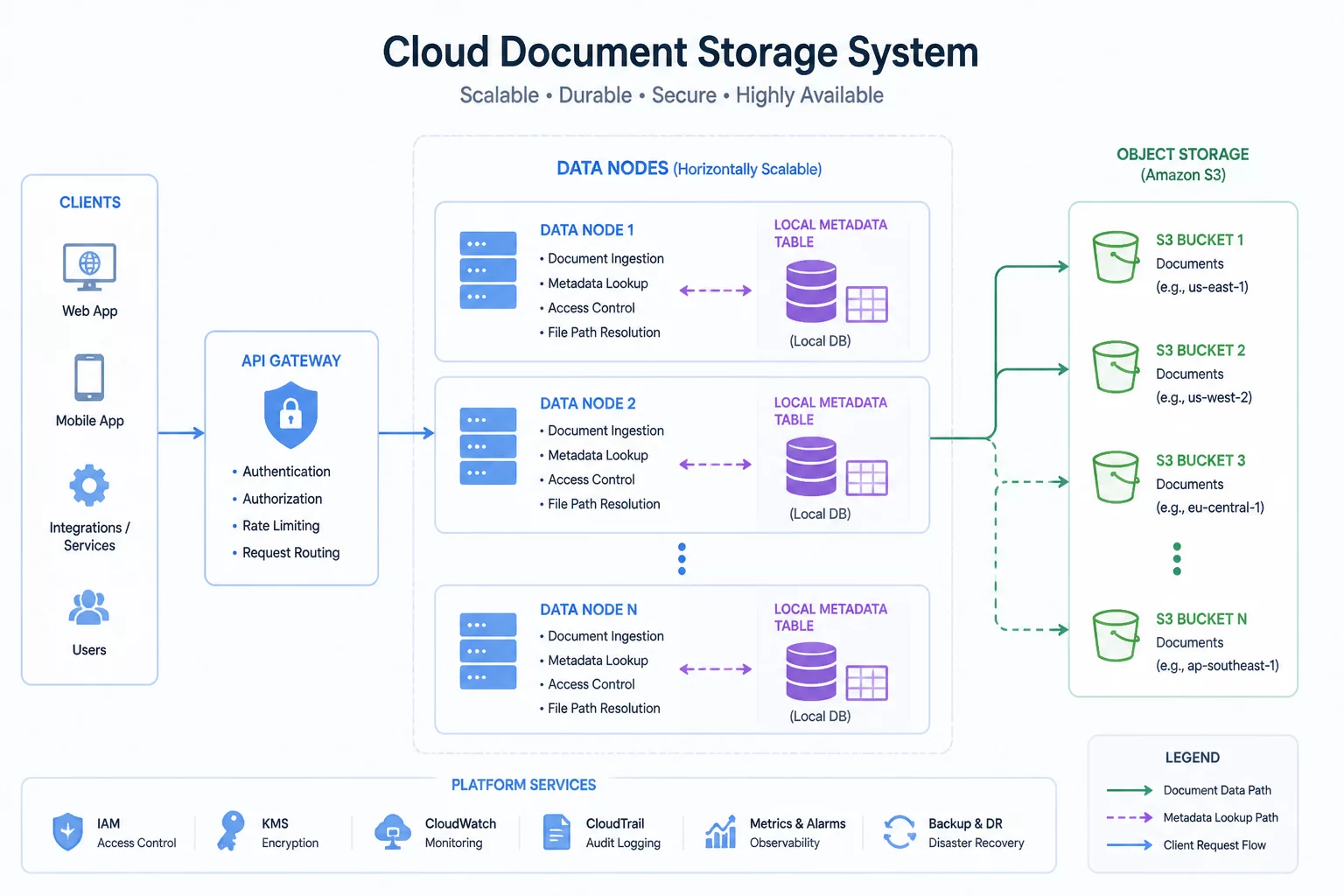
The Document Storage Schema serves as the fundamental blueprint for managing files, attachments, and binary data within a structured system. It addresses the inherent challenge of maintaining a link between logical database records and physical file locations, whether they reside in specialized storage buckets, file systems, or as BLOBs within the database itself.
The Core Intent
This pattern focuses on decoupling metadata from actual binary content. By doing so, developers can perform fast queries on file properties—such as mime-type, size, owner, and creation date—without loading the heavy binary payload into memory. It establishes a clear ownership model where a document belongs to a specific entity, such as a user or an organization, ensuring that access controls remain consistent across the application.
Structural Components
- Metadata Registry: Stores the authoritative description of each file.
- Versioning Engine: Tracks historical changes, allowing for point-in-time recovery.
- Storage Provider Mapping: Abstracts the physical storage location, enabling easy migration between cloud providers or local disks.
- Checksum Validation: Ensures data integrity through MD5 or SHA-256 hashing during both upload and retrieval.
Engineers usually choose this pattern when they need to build robust content management systems, e-discovery tools, or collaborative platforms where document integrity and auditability are non-negotiable. It avoids the common pitfall of «orphaned files» by strictly enforcing relational links between the document metadata and its associated business objects.