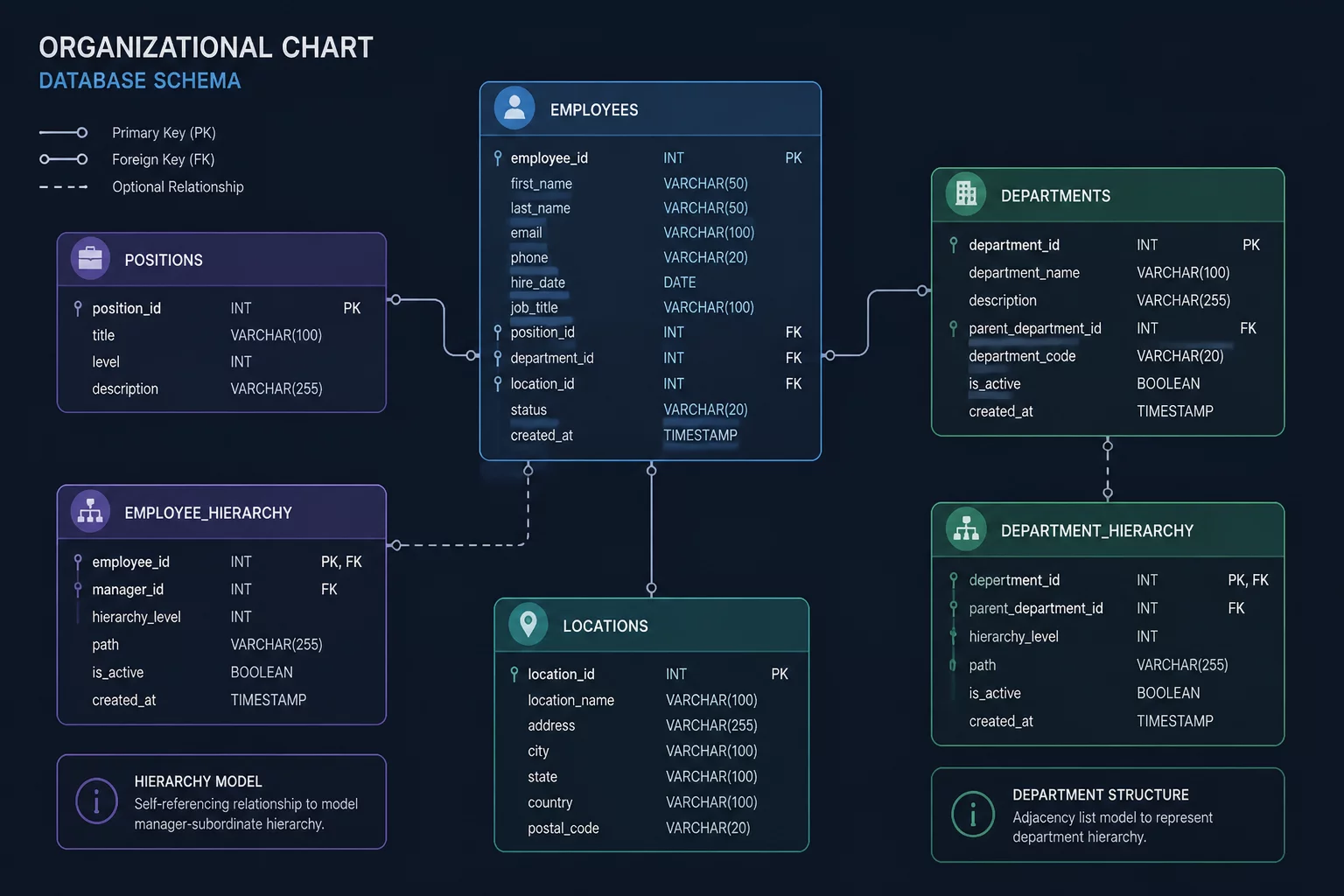
Direct Intent and Scope
The Employee Record Schema serves as the central repository for all human resource information within an enterprise. Its primary intent is to provide a single source of truth for employee identity, organizational placement, and historical employment milestones. By decoupling personal details from operational role data, this schema ensures that even as people move through different departments or leave the organization, the integrity of the corporate history remains intact.
Core Organizational Entities
A robust employee schema typically centers on the 'Employee' entity, which holds unique identifiers and permanent personal data. However, the real complexity lies in the relational layers. The 'Position' table describes the requirements and responsibilities, while 'Department' defines the structural grouping. A 'Job Assignment' table acts as the bridge, linking a specific person to a specific position for a defined period. This many-to-many relationship allows for employees holding multiple roles simultaneously or transitioning seamlessly between them over time.
Temporal Tracking and Auditing
Unlike simple user profiles, employee records must account for the dimension of time. Every promotion, pay change, or department transfer needs a start date and an end date. Using effective dating or temporal tables is a common strategy here. This allows the system to look back and determine exactly who was in which role on any given date in the past, a requirement that is crucial for financial auditing and legal compliance. Instead of overwriting old records, the schema appends new versions, maintaining a continuous timeline of the professional journey.
Relational Dependencies and Security
The schema relies heavily on foreign keys to external systems like Payroll and Identity Management. Security is a paramount concern; sensitive data such as social security numbers or salary information are often abstracted into side tables with restricted access controls. This layered approach ensures that standard application queries can fetch public directory information without exposing PII (Personally Identifiable Information).