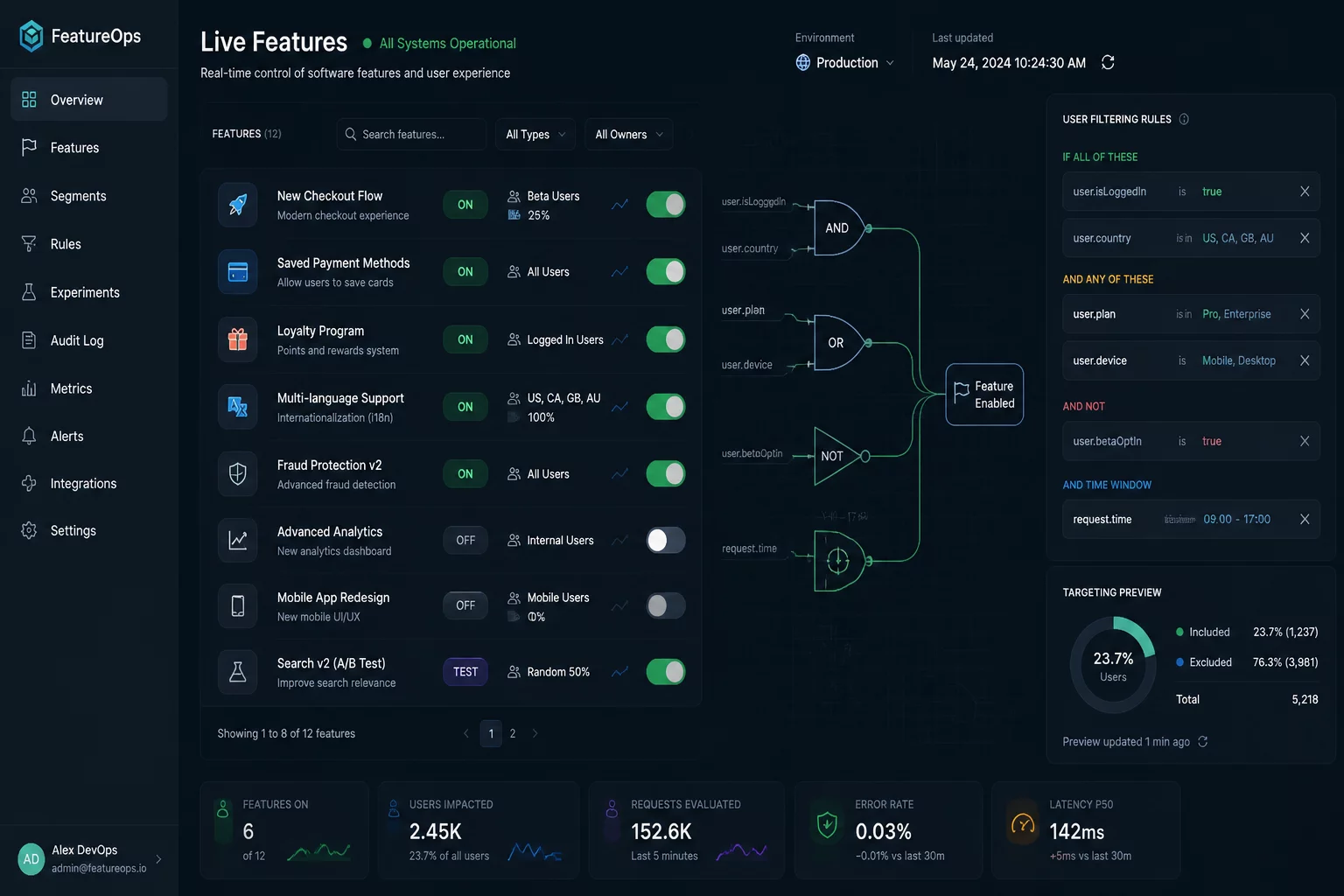
A feature flag schema forms the backbone of modern continuous delivery pipelines. By decoupling code deployment from feature release, teams can perform canary rollouts, run A/B tests, and instantly kill malfunctioning features in production without redeploying code. Achieving this level of operational agility requires a highly optimized database structure designed for fast lookups, low read latency, and clear governance.
Core Architecture and Schema Relations
To design an enterprise-grade feature toggle system, the schema must support multiple environments, target segments, and rules evaluation. We model this using five main tables that isolate environment-specific states from flag definitions and demographic rules.
1. The Flags Definition Table
This table acts as the source of truth for the existence of all toggles across the organization. It stores basic metadata, flag key, return type (boolean, string, or JSON for multivariate flags), and default states. Every flag key is protected by a unique constraint to ensure integrity across microservices.
2. The Target Segments and Rules Engine
To run targeted rollouts, we define user groups or cohorts. The segments table stores rules encoded in JSONB format, containing criteria such as geographic location, user email domains, or subscription status. The system evaluates these rules dynamically at runtime rather than executing heavy SQL joins.
Optimizing for Scale and Low Latency
Feature flags are evaluated on almost every user request, meaning database query latency is critical. We recommend deploying a robust indexing strategy to prevent full table scans. Storing active environment-flag pairings in an in-memory caching system like Redis reduces direct hits on the primary PostgreSQL database to near zero.
Adding composite indexes on the (flag_id, environment_id) columns in the environment mapping table ensures that any database fallbacks complete in sub-millisecond times. Additionally, audit logging is decoupled into a separate write-heavy log schema to keep the primary transactions clean and efficient.