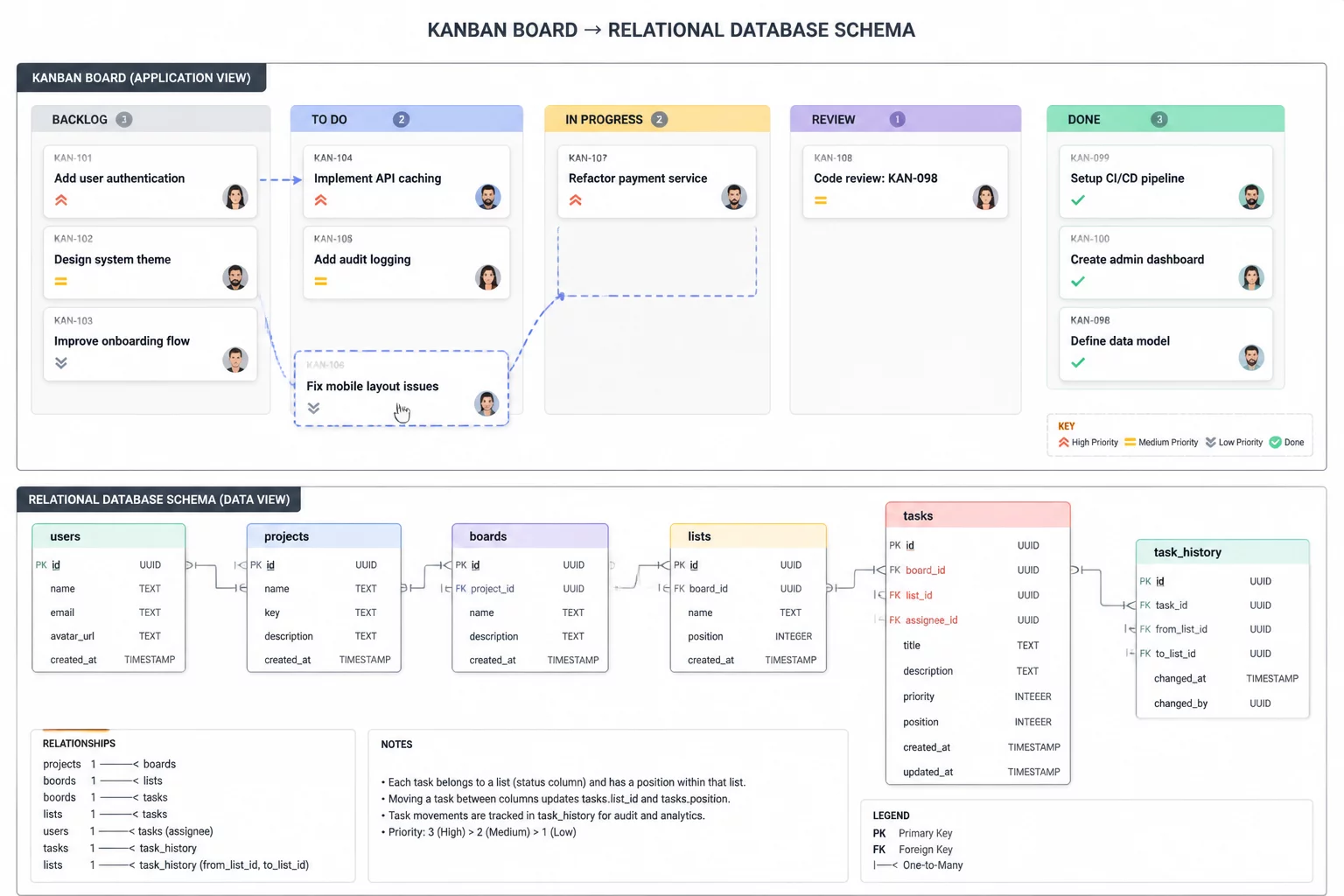
Issue Tracking Schema: Architectural Design for Efficient Workflows
An Issue Tracking Schema is a specialized database structure designed to manage the lifecycle of tasks, bugs, and feature requests within a collaborative environment. Unlike simple to-do lists, these schemas prioritize historical traceability, multi-user assignment, and complex state management. At the heart of this system lies the 'Issue' or 'Ticket' entity, which connects users, projects, and specific metadata like priorities and severities.
Relational Foundations of a Ticket System
In a well-designed issue tracking database, normalization is key to maintaining data integrity across thousands of active entries. A typical implementation separates core issue data from its volatile components. The 'Issues' table stores immutable or semi-permanent data like the creation timestamp, reporter ID, and unique identifier. Relationships are then established with 'Projects' and 'Labels' tables to categorize the work. By using foreign keys for status and priority, engineers ensure that queries for 'Open High Priority Bugs' are indexed and lightning-fast, even as the dataset grows.
Status Transitions and State Machine Integrity
Managing the 'state' of an issue is perhaps the most critical function of this schema. Simply updating a 'status' column is rarely sufficient for enterprise applications. Instead, the schema often incorporates a 'Status History' or 'Transitions' table that acts as a ledger. This captures who changed the status, when they did it, and what the previous value was. This approach not only provides a built-in audit trail but also allows for complex reporting on 'Lead Time' and 'Cycle Time,' metrics that are vital for teams monitoring their development throughput.
Extensibility through Meta-Attributes
Because every organization has different tracking needs, the Issue Tracking Schema must allow for extensibility. This is frequently achieved through a 'Custom Fields' pattern—a separate table that links to the issue and stores key-value pairs. While this adds complexity to joins, it prevents the main 'Issues' table from becoming a 'wide table' with hundreds of sparse columns. Effective indexing strategies on these meta-tables allow teams to filter by bespoke criteria without degrading the performance of the core application database.