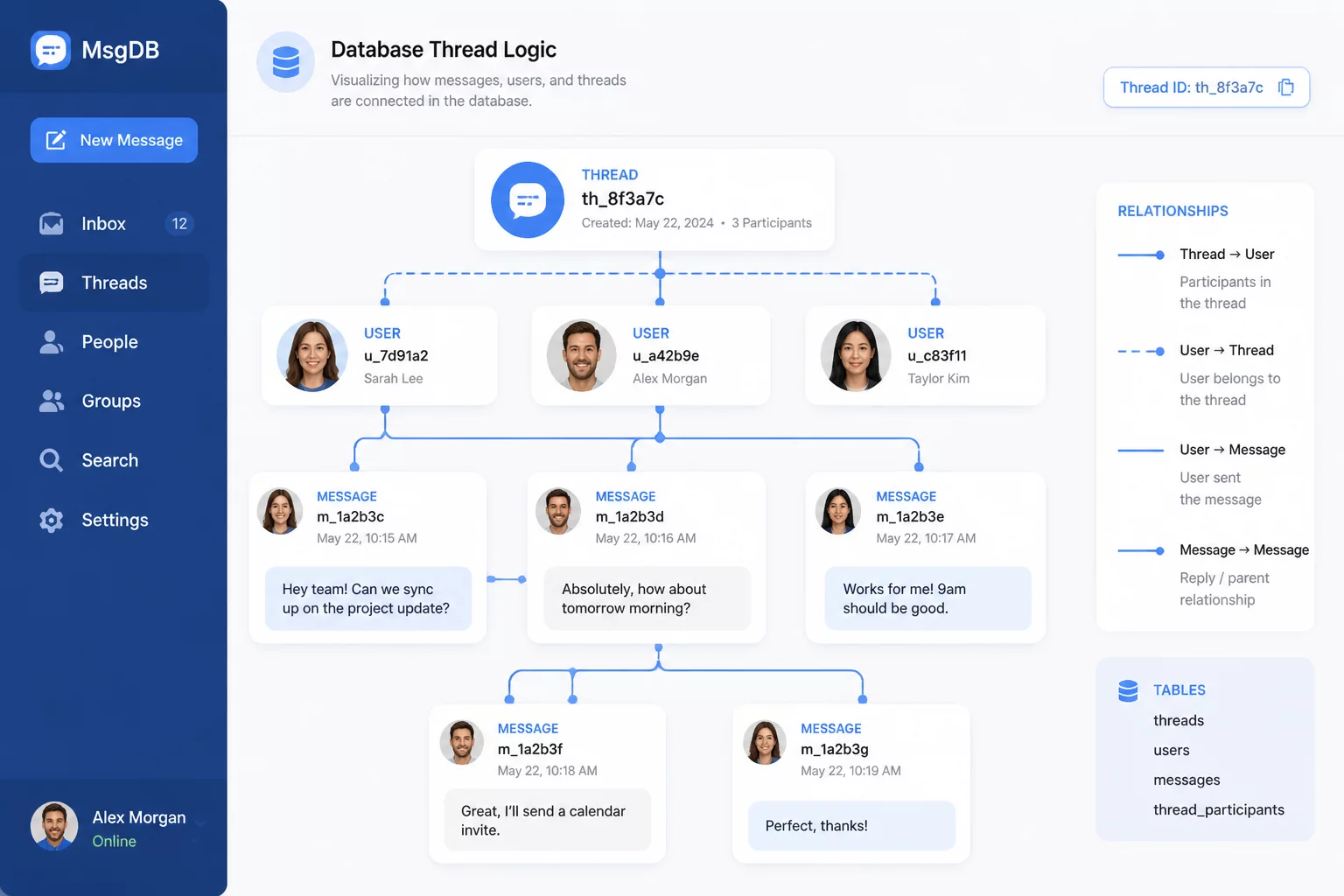
A Message Thread Schema provides the structural backbone for any application requiring persistent, grouped communication between users. This pattern goes beyond simple message storage by defining how individual entries relate to a parent conversation and how different participants maintain their unique state (like read status or archive flags) within that shared context.
Core Entities and Their Intent
The central 'Threads' table acts as a lightweight metadata container, storing properties like the creation timestamp, thread type (direct vs. group), and optional title. It serves as the primary anchor for all relational lookups. The 'Messages' table then references a specific Thread ID. To ensure high performance, developers often implement a sequence number or a high-precision timestamp to order messages without relying solely on auto-incrementing primary keys which might cause collisions in distributed systems.
Managing Multi-User Participation
The 'Participants' table is a junction that connects Users to Threads. It holds user-specific data that shouldn't live in the global Message table. For instance, the 'Last Read Message ID' or 'Is Muted' flag belongs here. This separation allows the system to calculate unread counts for thousands of users simultaneously without scanning the entire message history of every thread they belong to.
Optimization Strategies for Scale
When threads grow to thousands of messages, indexing becomes critical. A compound index on (thread_id, created_at) is the most common optimization. Furthermore, for real-time applications, storing a 'Last Message Snippet' directly on the Threads table reduces the number of joins needed to render a user's inbox view, though this introduces a small denormalization trade-off that requires careful synchronization.